
Name
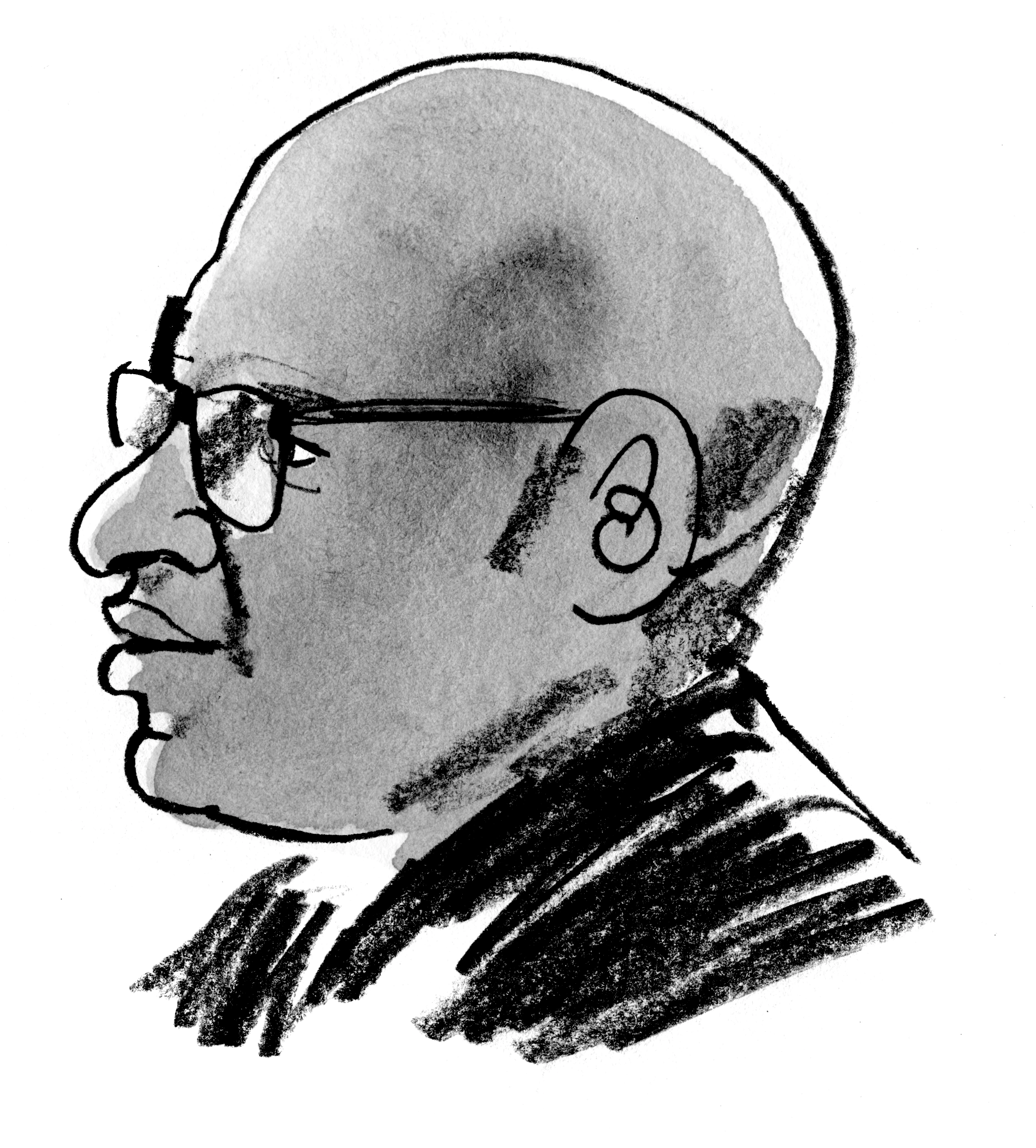
Judge Kenneth Holder
Title of Offense

Queens State
Supreme Court,
Criminal Term
Judge Kenneth Holder
Elected
2006
Term Ends
2029
Serving On
Queens State
Supreme Court,
Criminal Term
Education
- Lincoln University (BA)
- University of Toledo College of Law (JD)
Previously
- Prosecutor in the Queens district attorney's office
- Civil Court judge in Queens
- Brooklyn Criminal Court judge
- Brooklyn State Supreme Court judge, Civil Term
Judicial Metrics
Excessive Sentence Reductions:
Six reduced sentences, 41 years, a higher reduction than 99.33 percent of judges statewide
According to data compiled by the group Scrutinize, Holder had more excessive sentence findings than 99.78 percent of judges who sentenced felony cases in Nassau, Suffolk, Westchester, Orange, Rockland, Dutchess, and Putnam counties, as well as the five counties of New York City, in the time period from January 2007 to December 2025. That resulted in more years being removed from his sentences by the appeals court than 99.33 percent of judges in Scrutinize’s dataset. Reductions of this kind are unusual, but over 60 judges have had two or more sentences reduced in this way over the past two decades.
Who Is This Judge?
Kenneth Holder is another Queens prosecutor-turned-judge. In the case of Holder, attorneys say he leans into harsh sentences, lashes out often, and asks inappropriate questions in court.
Holder was born in London to a Jamaican mother and Guyanese father, and lived in Canada and Jamaica before moving to New York City.
Although he originally wanted to work in entertainment[1], his mother had a connection to the Queens district attorney’s office. In 1985, Holder joined the DA’s office as a prosecutor, and rose in the narcotics bureau during his 20-year tenure.
1. During a 2018 podcast interview, Holder revealed that after returning to Queens from law school, his mother, who was head of nursing at Jamaica Hospital, was coworkers with the brother of the then-Queens district attorney, John Santucci. “Next thing you know I’m getting a call…I got an interview and I went down there and I got the job,” Holder recalled. He said it was the only job he applied for.
In 2006, Holder began a journey many judges take through the bowels of the courts system, making brief stops in various courts before finding his way to the State Supreme Court. He ran for and won his race to become a Queens Civil Court judge, and then was swiftly assigned to Brooklyn Criminal Court and, for a brief period of time, to State Supreme Court in Brooklyn.[2] Holder was nominated and then elected to the Queens State Supreme Court in 2008 and again in 2021, meaning he’ll be in office until December 31, 2029.
2. Judges are shifted around by the Office of Court Administration depending on vacancies and need.
Holder had a reputation for being something of a reformer during his prosecutor days. In the 1990s, during the height of the so-called crack epidemic, he helped build the Queens Treatment Court model, which let defendants avoid prison time if they agreed to seek treatment for substance abuse.
But more recently, Holder has been unusually harsh toward defendants and their attorneys, according to attorneys we spoke with.[3]
3. A study by the group Scrutinize and Chad Topaz found that judges who used to be prosecutors or police officers were on average 3.9 percentage points more likely to detain people pretrial than other judges, and set significantly higher cash bail amounts.
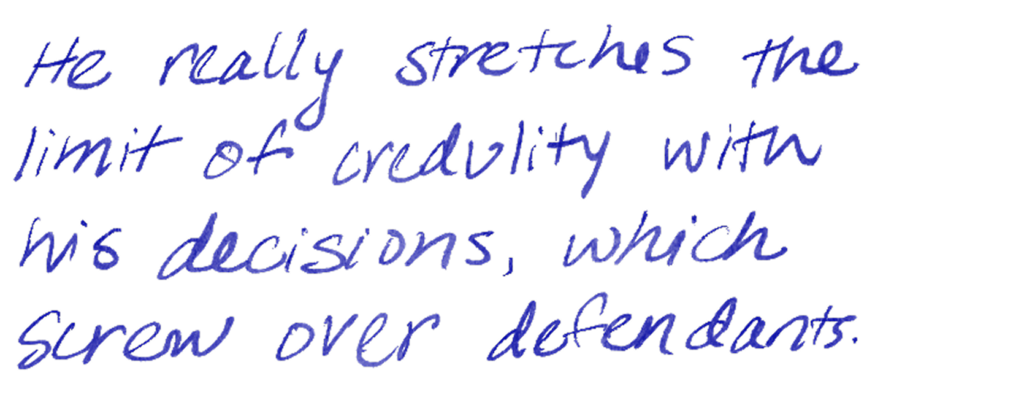
Two defense lawyers told Hell Gate and Type Investigations they believe Holder is biased toward the prosecution. “He really stretches the limit of credulity with his decisions, which screw over defendants,” said one lawyer.
Hell Gate has reported on this dynamic before. Recently, for example, Holder presided over the ultimately failed prosecution of Prakash Churaman, who in 2014 at the age of 15 was charged with felony murder during a botched robbery, which he ultimately confessed to during an interrogation. Churaman’s conviction was overturned by an appeals court in 2020, which ruled that Judge Holder had inappropriately excluded a defense expert who could testify about the unreliability of confessions.
Record on Sentencing
As a State Supreme Court judge, Holder is responsible for handling almost every phase of a criminal trial, from arraignment through sentencing. Attorneys we spoke to said that Holder is extremely harsh to defendants at almost every trial phase—and repeatedly, higher courts have found that Holder has handed out sentences that are too long.

It’s rare for a higher court to reduce the sentence imposed by a trial judge solely “in the interest of justice”[4]—but for Holder, that’s happened at least six times, making the judge an extreme outlier when it comes to harsh sentencing. From murder cases to nonviolent felony crimes like grand larceny, the state’s higher courts have found that Holder’s sentences were excessive. (Holder also had one case’s outcome not only reversed but reassigned to another judge, because one of the prosecution’s witnesses was married to Holder’s law clerk.)
4. Per Scrutinize and NYU Law’s Center on Race, Inequality and the Law: “In New York, appellate courts review sentences for excessiveness and can reduce them in the ‘interest of justice,’ a rare and clear signal…that a lower court judge made an exceptionally troubling choice.”
In one case, the higher court reduced the sentence of a man who was convicted of firing a gun at another man and two police officers (hitting neither) from 20 years to 10 years. In another case, where a chaotic bar fight[5] ended in a man stabbed to death by someone who was being beaten, the appellate court thought an acquittal was not out of the question based on the evidence, and lowered the sentence of the stabber from 20 years to 10 years.
5. Here’s just a taste of the action from the appellate court decision: “DeFilippis then turned her attention back to the fight, where she saw ‘a huddle of people’ surrounding the defendant on the floor, and it appeared that Savillo was kicking the defendant. DeFilippis testified that the defendant ‘was getting beat up pretty bad’ and that Savillo threw a bar stool at him, but that she thereafter ‘kind of blanked out’ and did not recall much about the fight or see anyone with a knife. DeFilippis called 911 and requested an ambulance, and she testified that it was at this time that Colucciello locked the door to the bar to keep Tommy out.”
Inappropriate Behavior
By the spring of 2022, the case of Prakash Churaman had become a very public problem for Judge Holder.
For one, an appeals court had already ruled that Holder had erred by not allowing defense counsel to present an expert who would have cast doubt on the reliability of a confession from a 15-year-old, and had ordered a new trial.
For another, advocates were outraged that Churaman had already spent a significant part of his youth at Rikers Island and then had to stay another six months at the jail after this case was overturned at the height of the COVID-19 pandemic. Churaman was an outspoken critic about the jail’s conditions, and Holder was facing pressure from advocates because of his refusal to let him go home. (Eventually, the courts released him to house arrest.)
Hell Gate then published our investigation into the reliability of the two detectives at the center of the Churaman case, finding that the detectives had allegedly withheld exonerating evidence in another case. Just days after its publication, Holder called an emergency hearing in the case. But it was not to address the issues that Hell Gate had uncovered. Instead, he yelled at Churaman’s defense attorney, Jose Nieves, for speaking to the press.
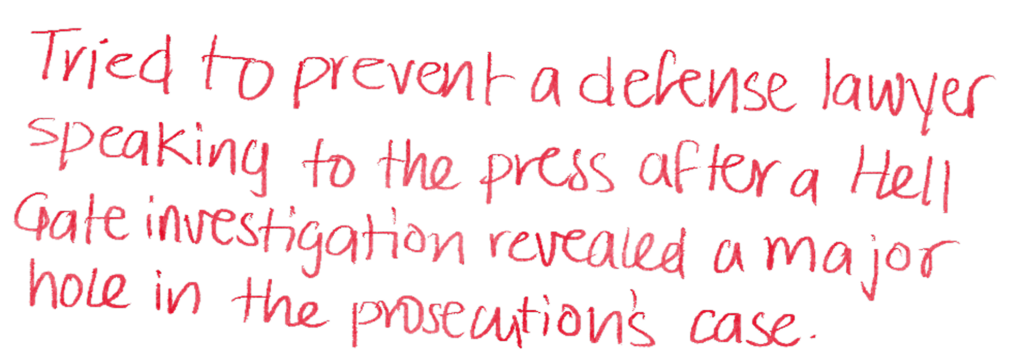
“The press might look for this, for that, but the only side that gets reported on in the media are things that have been unfair treatment to your client. It just seems a little odd,” Holder said to Nieves, implying that the defense had been leaking information to Hell Gate.
But Nieves had nothing to do with Hell Gate’s reporting, and he was unaware of the details that Hell Gate had dug up until we asked him about them. Still, even as Nieves explained to the judge that the defense had not coordinated with the media, Holder barked out, “This is my courtroom, don’t you forget it,” before ordering Nieves and Churaman to only share information related to the case at Nieves’s office.
“This is becoming a scenario where you could improperly affect the fairness of the jury,” Holder said, just before issuing his order. He then implied that he himself was holding back critical information. “I know enough about this case that would shock you,” he said.
Just what Holder was referring to was left unexplained.
Holder has also stretched the limits of what a judge may ask in court.
In one case in October 2025, in which a defendant was pleading guilty to a misdemeanor after prosecutors agreed to drop felony charges, Holder demanded to know if the person was a U.S. citizen.
The state’s appeals court has found that judges are not supposed to ask about the legal immigration status of a defendant during plea proceedings; they are simply meant to tell all defendants that if they’re not a U.S. citizen, pleading guilty to a crime could have meaningful consequences for their immigration status, and to consult with their lawyer.
Flying in the face of this guidance, Holder pushed the defendant to say in court whether he was a citizen or not, despite his lawyer’s protests.

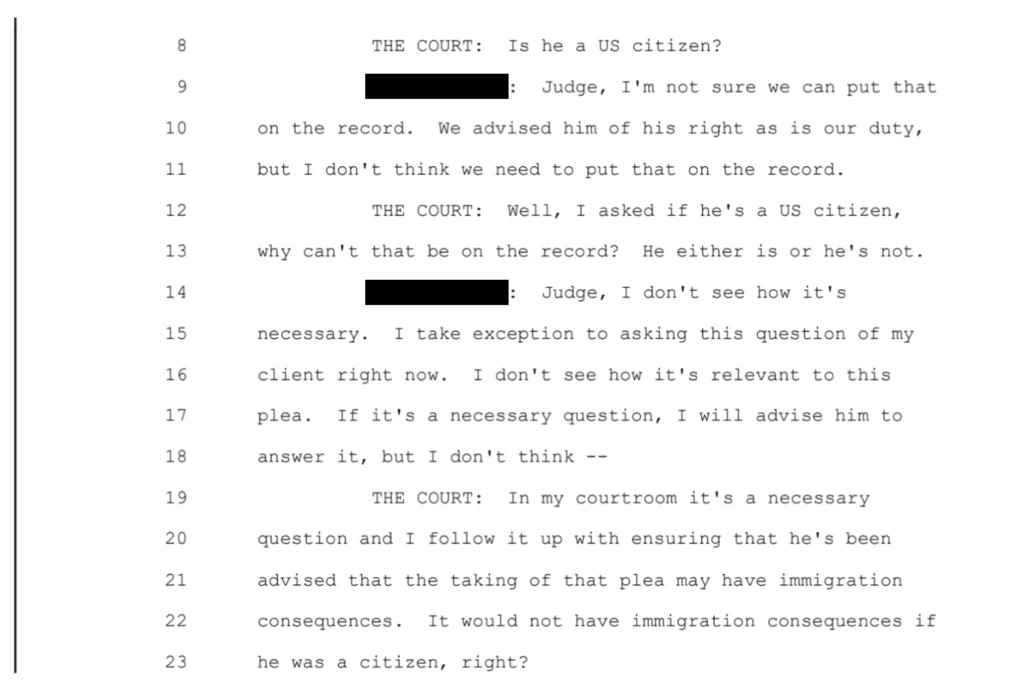
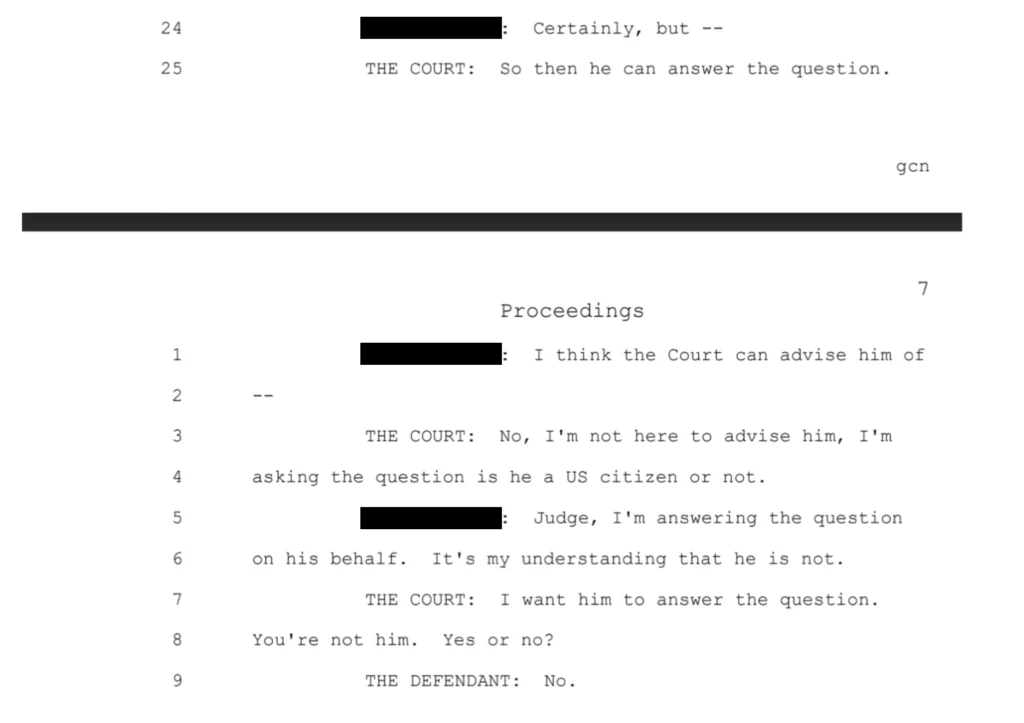
Eventually, even as ICE agents were stalking courthouses, Holder finally got the defendant to admit his immigration status in court.
What part of the broken system does he represent?
Holder, like several other Queens judges, appears hostile to defendants—which makes sense, given that for 20 years, and almost immediately before he sat on the Queens bench, he was tasked with prosecuting them.
Holder has been given, at times, supervision of the county’s entire Criminal Court, and he’s been endorsed for election by the Queens Democratic Party.
Rebuttal
We reached out to OCA multiple times via email and phone with a detailed list of questions. Unfortunately, OCA did not provide any answers.