
Name
Judge Ushir Pandit-Durant

Title of Offense

Queens State State
Supreme Court,
Criminal Term
Judge Ushir Pandit-Durant
Elected
2015
Term Ends
2032
Serving On
Queens State State
Supreme Court,
Criminal Term
Education
- St. John's University (BA)
- New York Law School (JD)
Previously
- Prosecutor in the Queens district attorney's office
- New York City Civil Court judge in Queens
- New York City Criminal Court judge in Manhattan
Judicial Metrics
Evidence suppression reversal rate:
One out of three evidence suppression-related appeals
Total excessive sentence reductions:
Two reduced sentences, 7 years total, a higher reduction than 91.54 percent of judges in Scrutinize’s dataset
**NOTES ON JUDICIAL METRICS**
When it comes to her evidence suppression reversal rates and excessive sentence findings by the appellate court, Pandit-Durant’s numbers put her in the upper echelon of judges whose rulings get scrapped.
According to data compiled by the group Scrutinize, she has had three evidence suppression-related appeals filed related to her cases, and her suppression reversal rate is higher than almost 95 percent of judges in the state who have had at least one evidence suppression-related appeal between 2007 and 2025.
During those years, Pandit-Durant also had excessive sentence findings in 2 cases, which is more than almost 96 percent of judges who sentenced felony cases in Nassau, Suffolk, Westchester, Orange, Rockland, Dutchess, and Putnam counties, as well as the five counties of New York City. That resulted in more years being removed from her sentences by the appeals court than 91.54 percent of judges in Scrutinize’s dataset. Reductions of this kind are unusual, but over 60 judges have had two or more sentences reduced in this way over the past two decades.
Who Is This Judge?
Judge Ushir Pandit-Durant immigrated to Flushing, Queens, from India when she was a child. She’s spent more than a decade as a judge in New York City, eventually rising to the State Supreme Court—in fact, she was the first South Asian woman to be elected to that position.
Pandit-Durant graduated from New York Law School and became a prosecutor[1] at the Queens district attorney’s office in 1987. In 2013, she donated $100 to the Queens borough president campaign of Melinda Katz, future Queens district attorney. In 2015, Pandit-Durant received the South Asian Public Service Award for her work at the DA’s office, the same year she ran for and won a race to be a Civil Court judge in the borough. But by 2016, Pandit-Durant had been shifted to Manhattan Criminal Court by the Office of Court Administration—a common practice aimed at combatting a perpetual shortage of Criminal Court judges in the city. Then, in 2018, Pandit-Durant ran to become a Queens State Supreme Court judge, and once again emerged victorious.
1. A study by the group Scrutinize and Chad Topaz found that judges who used to be prosecutors or police officers were on average 3.9 percentage points more likely to detain people pretrial than other judges, and set significantly higher cash bail amounts.
“There was nobody that looked like me when I became an ADA,” Pandit-Durant reflected at a mentoring event in 2021. At the same event, she encouraged attendees who’d practiced law for a decade or more with “a sense of justice” to follow in her footsteps and become a judge themselves.
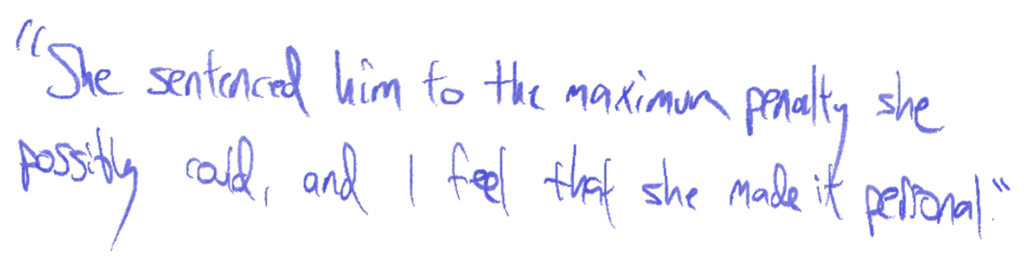
But according to some attorneys who’ve appeared in her courtroom, Pandit-Durant’s example isn’t always worth following: She’s been described as a judge who belittles attorneys in front of their clients, while appeals court judges have found—and corrected—serious issues with the sentences she’s handed out over the past seven years she’s held her seat in State Supreme Court.

Record of Reversals

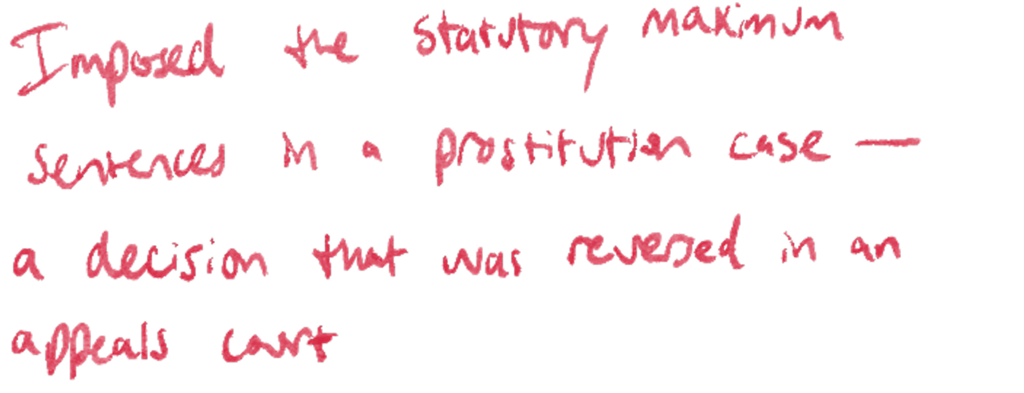
In 2023, the appeals court reduced sentences for two people who passed through the judge’s courtroom. In July of that year, an appellate court judge deemed that the enhanced sentences imposed by Pandit-Durant for a man with multiple convictions related to facilitating sex work were overly punitive. When reducing his sentences, the appeals court noted Pandit-Durant gave no reason for imposing the longer terms and the defendant’s criminal record included no violent offenses.
Pandit-Durant was also reversed by the higher court for overlooking the violation of a defendant’s rights. In 2020, she presided over a case in which a man pleaded guilty to criminal possession of a weapon in the second degree. Pandit-Durant had denied that man’s motion to both strike a statement he had made to police and to suppress the gun that had been recovered from his pocket, which was only found due to an unconstitutional stop-and-frisk. The appeals court vacated the plea in 2024, finding that Pandit-Durant had erred by admitting the evidence and that the arrest itself was unlawful.
And in 2025, an appeals court found that Pandit-Durant had also erred when she overstated the causal relationship between marijuana use and the crimes of a man convicted of sexual abuse in the first degree. The ruling led to the man being downgraded from a level-three sexually violent offender to a level-two sexually violent offender in the state’s registry, thereby reducing his reporting obligations as a person on the sex offender registry.
We asked Pandit-Durant, via OCA, about her record of reversals by the appellate court; we did not get a response.
Courtroom Demeanor
Hell Gate and Type Investigations spoke to two defense attorneys who described Pandit-Durant as openly hostile to defense attorneys who appear in front of her. “She’s so used to saying ‘overruled,’ like, before you even finish your sentence—’overruled.’ It doesn’t really matter what you’re saying,” one of those attorneys said.
According to a court transcript, in a recent case involving allegations of sexual abuse, Pandit-Durant dismissed a juror who said he needed a longer break from deliberations because he needed to attend services at his mosque, because the juror had repeatedly been late to proceedings. She then appointed an alternate juror in his stead, even though she had already dismissed both alternates who’d been on standby during the trial.
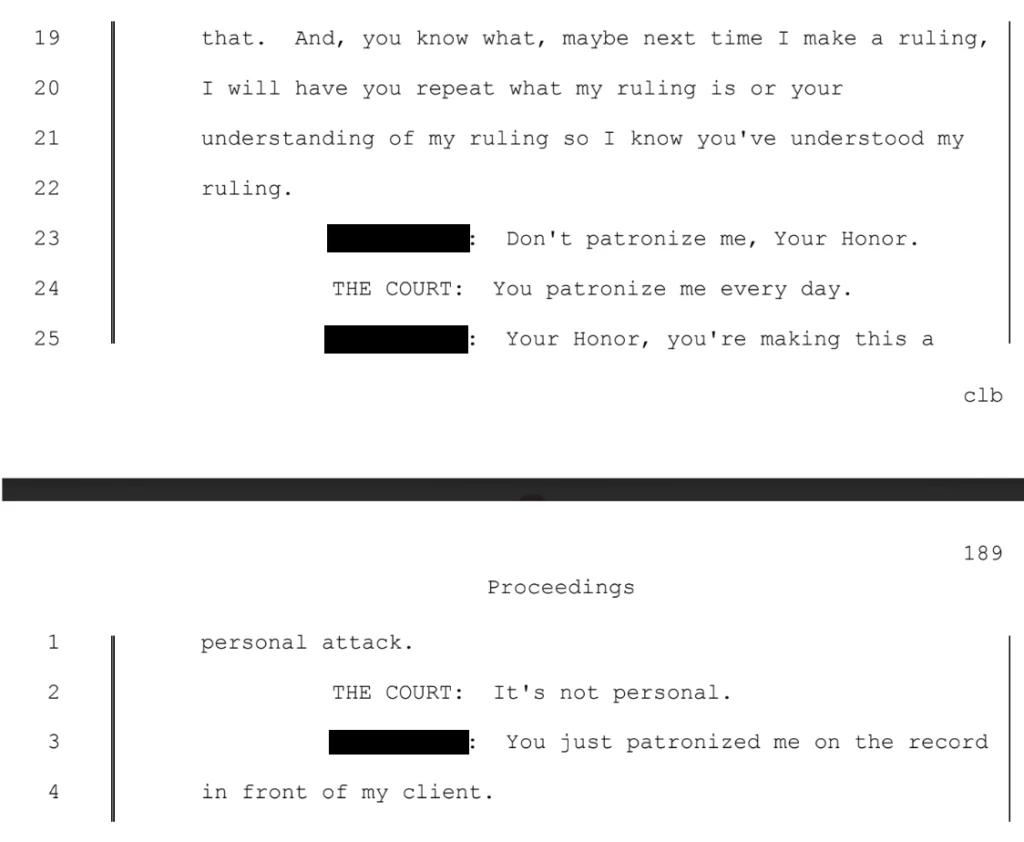
Earlier in the same trial, the judge got into a series of spats with the defense attorney, according to a transcript of the proceedings. Here’s one example:
And in May 2025, a defense attorney observing the trial of a man charged with a random, fatal attack on an emergency medical technician said they saw the judge make a move they’d never seen before: Pandit-Durant overruled two psychological experts employed by the New York state court system who deemed the defendant mentally unfit to stand trial. The experts, according to a New York Times report, described the defendant as “delusional and psychotic with an impaired ability to evaluate his options,” with one noting that the defendant was operating under the belief that the evidence against him “had been faked.” Pandit-Durant chose to proceed with the trial anyway, citing one of the experts’ description of the defendant’s thinking as “organized and coherent.”
While judges have the power to overrule such recommendations, they rarely do, according to one 2012 study. Pandit-Durant also blocked the defense from introducing evidence about the defendant’s mental illness during the trial. “She precluded any mention of his mental status,” the attorney said. As they recalled from the trial, “So when he took the stand, [the defense attorney] said, ‘Where do you sleep in the apartment?’ Trying to elicit [the fact that] he sleeps on a twin bed with his mom, [as] this grown adult—[Pandit-Durant] precluded every single thing about it.”
In the end, the defendant was found guilty of second-degree murder and criminal possession of a weapon; the judge applied the maximum sentence of 25 years to life.
On a Friday in April, Hell Gate and Type Investigations visited Pandit-Durant’s courtroom. Neither she nor the assistant district attorney arrived until a little after 10 a.m., more than an hour after the slated start time. In the face of the time-crunch, Pandit-Durant remained breezy, hurrying cases along and joking with her court staff. At one point, a defense attorney told everyone in the courtroom to “get home safe” before departing for the day. “‘Get home safe…’ Is there a storm coming?” Pandit-Durant said to her clerk. “It’s just regular Friday driving.” During a lull between cases, as attorneys played catch-up from the morning’s delay, the judge made it clear that she was fine with shuffling around the order of proceedings. “I don’t care,” she sang to the tune of Charli XCX and Icona Pop’s breakout hit, chuckling to a court reporter. “That song plays during my workout. That’s my song for everything.”
What part of the broken system does she represent?
Pandit-Durant’s ascension from the Queens DA’s office to the Queens State Supreme Court is yet another example of the prosecutor-to-judge pipeline.
But Pandit-Durant is far from the only former prosecutor on the bench in Queens—take a look at Judge Michael Aloise, whose daughter recently worked as a prosecutor in the county’s district attorney’s office, and whose son-in-law is currently a deputy bureau chief in the DA’s office, or Judge Kenneth Holder, who worked as a prosecutor for two decades and has a record of excessive sentence findings that actually outpaces Pandit-Durant’s.
Rebuttal
We reached out to OCA multiple times via email and phone with a detailed list of questions. Unfortunately, OCA did not provide any answers.